
Load Bank For DG Set Testing
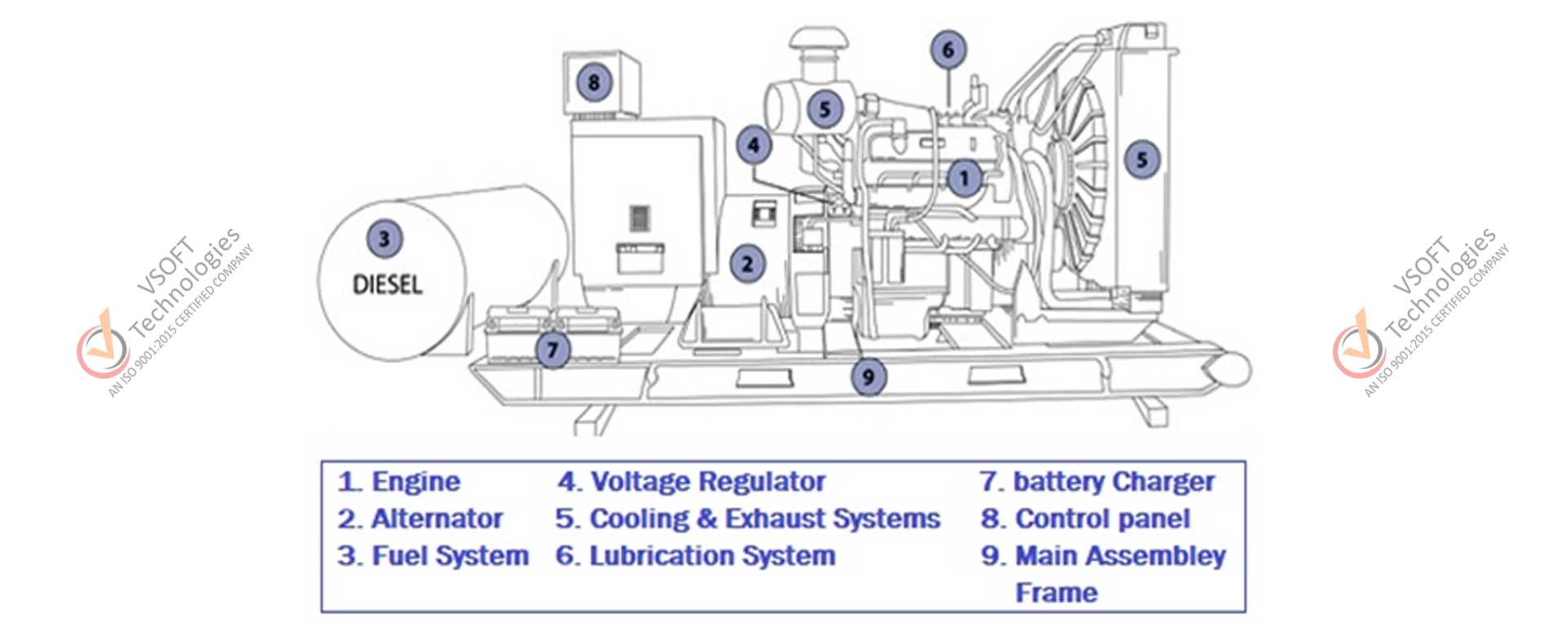
Testing of Load Bank through DG Set
What is DG (Diesel Generator) Set?
A power generation system that generates electricity by using a diesel engine to power an alternator.
Purpose:- In the event of a power outage, supply standby or backup power.
- Also used in load testing to replicate actual power loads for equipment testing (via load banks).
Key ISO 8528 Series – Main Standard for DG Sets
The main international standard that controls diesel generator sets' performance, testing, and categorization is this one:
- ISO 8528-1: General Requirements
Outlines the broad definitions, categories, and specifications for generator sets. - ISO 8528-5: Generating Sets – Performance
Requirements
Key standard for dynamic characteristics. Covers frequency and voltage dip, recovery time, load acceptance, overshoot, etc.
Defines generator set performance classes (G1–G4):
G1 – Basic requirements; large voltage/ frequency variation allowed
G2 – Stoddard Use; Moderate Regulation, Acceptable for most Industrial Loads.
G3 – High Performance; Suitable For sensitive Equipments(e.g. Data centre).
G4 – Very High Performance; Tightest tolerances, used for critical system. - ISO 8528-6: Test Methods
Outlines procedures for evaluating generator sets under diverse operational conditions. Includes methods for testing stability, transient behavior, load stages, etc. - ISO 8528-13: Special Tests
Emphasizes special-purpose testing, such as performance in unusual or non-standard circumstances (such as high ambient temperatures or altitudes). Beneficial for load bank testing under harsh circumstances. - ISO 3046 Series – Reciprocating Internal Combustion Engines.
- ISO 7637 (Particularly for Control
Electronics)
If the DG set has sophisticated electronic controllers, this standard helps evaluate electrical disturbances. - ISO 9001 (Quality Management) (Indirectly
relevant)
Ensures that manufacturing and testing of DG sets follow quality processes.
Standard Title Use in Load Bank Testing
| Standard | Title | Use in Load Bank Testing |
|---|---|---|
| ISO 8528-1 | General Requirements | Defines basic structure and ratings |
| ISO 8528-5 | Performance Requirements | Defines dynamic behavior under load |
| ISO 8528-6 | Test Methods | Specifies load bank testing procedures |
| ISO 8528-13 | Special Tests | Load testing in extreme/special conditions |
| ISO 3046-1 | Engine Testing | Test engine performance before coupling |
| ISO 9001 | Quality Management | Ensures quality of DG manufacturing and testing. |
Testing Load Bank through DG Set
In order to replicate real-world loads and assess the generator's performance under varied circumstances, load bank testing is an essential component of DG set testing. The DG set's load is progressively increased throughout this test, which also keeps an eye on important variables like engine response, voltage stability, and exhaust conditions.
Dynamic Characteristics
- ISO 8528-5 states that transient response, voltage flicker, and frequency deviations under various load circumstances are examples of dynamic characteristics of diesel generator sets (DGs) during load bank testing. The DG's ability to adjust to variations in load, including steady-state variation, frequency dips under abrupt increases in load, and frequency climbs upon load removal, is assessed by this test. Limits for voltage variations and recovery durations following transient events are also specified by the standard.
- The capacity of the DG to stabilize its output voltage and frequency following an abrupt change in load, such as a load bank raising or decreasing load, is known as transient response.
- Voltage Flicker:
During load bank testing, the variations in voltage output can be detected and examined. - Frequency Deviations:
ISO 8528-5 establishes upper and lower bounds for the maximum frequency increase and recovery time following load variations. Additionally, the standard outlines the steady-state frequency variation that must - Load Bank Testing:
This technique applies an artificial load to the DG to replicate real-world stress circumstances, enabling the assessment of these dynamic properties. - Testing Procedures:
ISO 8528-5 describes precise procedures for testing certain dynamic properties, such as how to monitor frequency and voltage variations and apply and remove load stages. - Performance Classes:
According to ISO 8528, DG performance is divided into several classes (such as G1, G2), each of which has distinct specifications for frequency deviations, transient response, and voltage flicker
Class G1 is applicable to generating set applications (such as general purpose applications, lights, and other simple electrical loads) when the associated loads are such that only the most basic voltage and frequency parameters need to be provided.
Applications for Class G2 generating sets are those whose voltage characteristics closely resemble those of the commercial public utility electrical power system they are used with. There may be brief but acceptable variations in voltage and frequency as load changes (e.g. Lighting systems, pumps, fans, and hoists).
Key Static Characteristics of a DG Set (as per ISO 8528)
- Voltage Regulation:
Generators maintain consistent voltage despite load changes, typically within ±1% to ±2.5% of the rated voltage. - Frequency Regulation:
Frequency deviation from the nominal value during load changes, until stabilization, is typically ±0.5% to ±2%, depending on the governor type. - Power Factor Capability:
Generators accommodate power factors ranging from 0.8 lagging (standard) to 1.0 (unity) at full load. - Steady-State Voltage and Frequency
Deviation:
Under constant load, acceptable voltage deviation is ±1% to ±2.5%, and frequency deviation is ±0.5% to ±1%. - Load Sharing (in parallel operation):
Multiple generators share loads proportionally and stably, assessed via load bank testing during parallel operation. - Efficiency:
Efficiency, the ratio of electrical output to fuel input, is evaluated during steady-state testing at various load levels (25%, 50%, 75%, 100%). - Fuel Consumption:
Fuel consumption (L/hr or g/kWh) is measured at different load points for cost and emissions analysis.
Difference Between Static and Dynamic Characteristics
| Aspects | Static Characteristics | Dynamic Characteristics |
|---|---|---|
| Definition | Steady-state performance | Transient performance (sudden load changes) |
| Load Condition | Constant load | Sudden load change (step load application/removal) |
| Focus | Stability and regulation during normal operation | Response and recovery from disturbances |
| Key Parameters | - Voltage regulation - Frequency regulation - Power factor - Efficiency - THD |
- Voltage dip/rise - Frequency dip/rise - Recovery time - Load acceptance |
| Testing Type | Steady load steps (25%, 50%, 75%, 100%) | Sudden load application/removal |
| Time Domain | Long-term behavior (seconds to minutes post-stabilization) | Short-term behavior (milliseconds to seconds) |
| Example | Voltage within ±2% at 75% load | Frequency dips 8%, recovers in 4 seconds after a 50% load step |